


News & Blogs

How to Choose the Right Cable Connectors?

Choosing the right Cable Connectors is rarely a simple matter of matching shapes. A connector may fit perfectly yet fail under heat, vibration, moisture, or repeated bending. Reliable selection begins with the application. Consider current, voltage, signal type, installation space, and expected service life before comparing brands or prices.

Field technicians often examine the cable jacket, conductor size, insulation material, and termination method together. Crimp connectors can provide consistent results when the correct tool is used. Soldered connections may suit delicate signal wiring, but they require careful heat control. In outdoor equipment, sealing ratings, corrosion resistance, and strain relief deserve close attention. A loose connector inside a control cabinet can create intermittent faults that are difficult to locate.

Manufacturer datasheets and recognized testing standards should guide the final decision. Look for verified temperature ranges, contact materials, mating cycles, and ingress protection ratings. Do not rely on appearance alone. Some inexpensive Cable Connectors perform well, while premium-looking parts may not match the cable or environment.

The details matter.

A practical selection process also includes a small trial installation. Check insertion force, cable pullout strength, and continuity after movement. It is easy to overlook maintenance access or future replacement needs. That mistake can become expensive.

No connector choice is perfect for every project. Requirements can change after installation. Careful documentation, honest risk assessment, and advice from qualified electrical professionals make the decision more dependable.
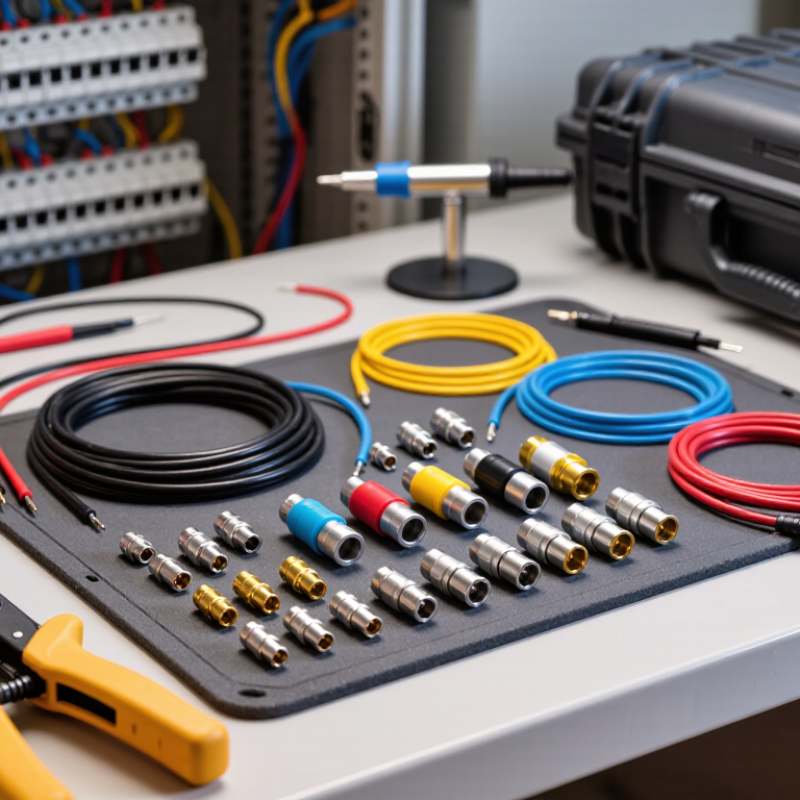
How to Choose the Right Cable Connectors?

Define Voltage, Current, Frequency, and Signal Requirements First

How to Choose the Right Cable Connectors?

Define Voltage, Current, Frequency, and Signal Requirements First

A reliable connector choice starts with four electrical facts: voltage, current, frequency, and signal type. Measure the real operating range, not only the nominal value. A 24-volt circuit may reach 28 volts during charging. That difference affects insulation and contact spacing. Current needs equal attention. Record continuous and peak loads separately. Motor startup can briefly demand several times its rated current. Choose contacts with thermal headroom, then check temperature rise under load. A connector that feels warm during a bench test deserves another review.

Frequency changes connector behavior. At higher frequencies, stray capacitance and inductance can weaken signal quality. For fast digital lines, check impedance, shielding, and return paths. For low-level sensors, inspect contact resistance and noise performance. Do not assume a power connector suits a signal circuit. It may fit mechanically and still distort measurements. Use an oscilloscope or network test when the signal is sensitive. Datasheets help, but actual cable length and routing can disagree. This is where many selection decisions become less certain.

Match the connector’s voltage and current ratings to the worst credible condition, including switching and fault margins. Confirm frequency limits, signal bandwidth, mating cycles, and environmental ratings. Moisture, vibration, dust, and repeated bending can change contact reliability. In one practical review, a connector passed the electrical calculation but failed after cable movement. The calculation was not wrong; it was incomplete. Build a sample harness and test it while warm, flexed, and fully loaded. Leave clear records of measurements, assumptions, and unresolved questions. Perfect data is rare. Careful doubt is useful.

Match Connector Types to Applications, Including USB-C PD up to 240 W

Choosing the right cable connector starts with the application, not the plug’s appearance. Check voltage, current, data speed, temperature, and mating frequency. A connector for a laptop may fail in a vibrating industrial cabinet. Small details matter.

For USB-C Power Delivery, the USB-IF Power Delivery 3.1 specification allows power delivery up to 240 W, using up to 48 V and 5 A. That level requires a compliant cable, suitable contacts, and electronic identification inside the cable. A thin charging lead may look identical but support far less power. Match the connector, cable rating, charger, and device together. One weak link can create heat.

Data transfer also needs attention. USB-C describes the connector shape, not guaranteed speed or power. Review the product’s technical report and test data before purchasing. For outdoor equipment, IEC 60529 ingress ratings help determine protection against dust and water. For repeated connections, inspect contact plating, locking strength, and strain relief. I have seen installations fail because the connector fit perfectly, but the cable bent sharply behind the panel. That was avoidable.

Do not assume 240 W is always better. Higher power increases design demands, heat, and safety margins. In practice, a lower-rated connector may be the more reliable choice for sensors, displays, or compact electronics. Specification labels can be incomplete. Verify them.

How to Choose the Right Cable Connectors? Match Connector Types to Applications, Including USB-C PD up to 240 W

Connector Type Contact or Interface Characteristics Typical Electrical or Data Capability Suitable Applications Key Selection Criteria Important Limitations
USB Type-C Reversible 24-contact connector; supports USB power, data, and alternate interface modes depending on the equipment and cable. USB Power Delivery can support up to 240 W using Extended Power Range equipment and a suitably rated cable. Data capability may range from USB 2.0 to higher-speed USB generations. Laptops, tablets, phones, monitors, docking stations, storage devices, cameras, and rechargeable equipment. Confirm the required power profile, cable current rating, data speed, video mode, connector gender, and whether electronic cable identification is required. USB Type-C describes the connector shape, not guaranteed performance. A Type-C port may support only USB 2.0 data and basic charging.
USB Type-A Rectangular host-side connector commonly used for legacy USB connections. Commonly used for USB 2.0 or USB 3.x data and low-to-moderate bus power. It is not the connector used for USB PD Extended Power Range up to 240 W. Desktop computers, older laptops, keyboards, mice, printers, flash drives, and charging adapters. Check the USB data generation, host or peripheral role, available current, and whether the equipment requires a newer reversible connector. Not reversible; practical power and performance depend on the USB specification implemented by the host and device.
USB Micro-B Compact keyed connector available in USB 2.0 and wider USB 3.x forms. Usually intended for USB data and basic charging. It does not provide the USB-C PD feature set. Older phones, cameras, GPS units, development boards, and small peripheral devices. Match the exact Micro-B variant, cable orientation, data requirement, and mechanical clearance. The connector is mechanically less robust than many newer designs and cannot be inserted reversibly.
USB Mini-B Older compact USB connector with a trapezoidal keyed profile. Generally used for USB 2.0 data and basic device charging. Older cameras, measurement instruments, audio equipment, and legacy embedded products. Verify the Mini-B pin configuration and the device-side connector before ordering. Less common in current designs; do not substitute Micro-B or Type-C without a compatible adapter or redesign.
HDMI Type-A 19-contact digital audio/video connector with a keyed, friction-fit design. Carries uncompressed digital video and multichannel digital audio. Supported resolution, refresh rate, HDR, and other features depend on the HDMI version and connected devices. Televisions, monitors, projectors, media players, game systems, and home-theater equipment. Match the required resolution, refresh rate, cable length, bandwidth, audio format, and connector accessibility. Does not provide general-purpose USB data or high-power device charging.
DisplayPort Digital video connector commonly using a locking or friction-fit full-size plug; smaller versions are also available. Supports digital video and audio with capability determined by the DisplayPort version, link rate, cable quality, and display configuration. Computers, professional monitors, docking stations, workstations, and multi-display systems. Check resolution, refresh rate, multi-stream requirements, cable length, latch clearance, and whether an adapter is passive or active. Connector compatibility alone does not guarantee support for the desired display mode or adapter direction.
RJ45 Modular Connector Eight-position modular connector commonly used with twisted-pair Ethernet cabling. Supports Ethernet data rates from legacy systems through multi-gigabit implementations when the cable category, termination, and network hardware are suitable. May also carry Power over Ethernet under the applicable standard. Network switches, routers, computers, access points, cameras, industrial Ethernet, and building networks. Match cable category, shielding, conductor type, wiring scheme, latch style, environmental rating, and PoE requirements. Performance can be reduced by poor termination, excessive length, electromagnetic interference, or incorrect cable category.
DC Barrel Connector Coaxial cylindrical plug and socket with defined outer diameter and inner-pin diameter. Used for low-voltage DC power; voltage, current, polarity, and temperature rating vary by design. No universal power rating applies to all barrel connectors. Routers, monitors, LED equipment, test instruments, small appliances, and embedded products. Match inner and outer dimensions, center-positive or center-negative polarity, voltage, continuous current, insertion depth, and locking method. Similar-looking sizes may not mate correctly. Incorrect polarity or voltage can damage equipment.
IEC Appliance Connector Family of standardized AC power couplers with appliance inlets and detachable power cords. Designed for mains power; current and temperature ratings depend on the specific inlet and cord type. Computers, monitors, laboratory equipment, audio systems, servers, and other mains-powered equipment. Verify the exact inlet shape, voltage system, current rating, grounding requirement, cord gauge, and regional plug configuration. Not intended for low-voltage DC connections. The correct connector family must be selected for the appliance inlet.
M12 Circular Connector Threaded circular connector available in multiple coding options and contact arrangements. Used for industrial power, sensor signals, actuator signals, and Ethernet depending on the coding, pin count, and specification. Factory automation, sensors, robotics, machine tools, industrial networking, and outdoor control systems. Choose coding, pin count, shield termination, ingress protection, current rating, cable flex life, and temperature range. Different coding types may look similar but are not necessarily compatible or electrically interchangeable.
JST-Style Wire-to-Board Connector Small-pitch board connector family available in many housings, pin counts, and contact pitches. Typically carries low-voltage power or signal circuits. Rating depends on the exact housing, terminal, wire size, and pitch. Consumer electronics, battery packs, LED assemblies, control boards, sensors, and compact devices. Confirm pitch, pin count, mating height, terminal orientation, wire gauge, current rating, locking feature, and polarization. Similar pitches and shapes are not automatically interchangeable; use the exact mating housing and terminals.
3.5 mm Audio Jack Small cylindrical analog audio connector available in two-, three-, or four-contact configurations. Carries analog audio signals; contact assignments vary between stereo, microphone, remote-control, and balanced configurations. Headphones, microphones, portable audio equipment, test equipment, and auxiliary audio connections. Check contact count, plug length, stereo or mono wiring, microphone support, impedance, and panel-mount requirements. Analog audio wiring is not universally standardized across all devices, especially for combined headset connections.

USB-C PD safety note: A USB Type-C connector alone does not guarantee 240 W charging. Up to 240 W requires compatible USB Power Delivery Extended Power Range source and sink equipment, an appropriately rated cable, correct power negotiation, and suitable thermal and electrical protection.

Select Data Connectors by Bandwidth, Such as Cat 6A at 500 MHz

How to Choose the Right Cable Connectors?

Select data connectors by bandwidth, not appearance or price alone. Cat 6A supports frequencies up to 500 MHz under ANSI/TIA-568.2-D specifications. That bandwidth helps control insertion loss, crosstalk, and signal distortion in dense networks. IEEE 802.3an defines 10 Gb/s transmission over suitable twisted-pair cabling up to 100 meters. The connector must match the cable category and installation method. A connector rated below Cat 6A can create a weak link. I once focused on cable quality and ignored the termination hardware. That shortcut caused unstable testing results. The lesson remains uncomfortable: every connection deserves equal attention.

Tips: Check the connector’s category, frequency rating, conductor compatibility, and shielding design. Confirm performance with field testing. Do not trust packaging claims alone.

For a 500 MHz Cat 6A system, choose connectors with verified insertion-loss and return-loss performance. Shielded connectors may reduce electromagnetic interference near motors, power lines, or server equipment. Unshielded designs can work well in quieter spaces. Cable diameter also matters. A connector may accept the category but still fit poorly around thicker conductors. Follow the manufacturer’s termination geometry, even when the instructions seem excessive. ANSI/TIA field-testing guidance also emphasizes permanent-link and channel measurements, not visual inspection alone. A neat installation can still fail certification. Recheck the result after moving cables or closing patch panels. Small bends can change the final measurement.

How to Choose the Right Cable Connectors?

Select data connectors by the frequency bandwidth supported by the cabling category.

Higher-category cabling supports higher signaling frequencies, but the connector, cable, patch panel, and installation must be rated for the same category. Cat 6A supports up to 500 MHz and is commonly selected for 10 Gigabit Ethernet over distances up to 100 meters when the complete channel is properly installed.

Evaluate Ingress Protection with IEC 60529 Ratings, Including IP67

How to Choose the Right Cable Connectors?

Ingress protection should guide connector selection, especially in outdoor and industrial equipment. IEC 60529:2013 defines IP67 as complete dust protection and resistance to temporary immersion in water up to one metre for 30 minutes. That rating describes a controlled test, not permanent underwater operation.

Short sentences matter here. IP67 is not waterproof forever.

Before choosing, inspect the complete connection. The cable jacket, seal, locking mechanism, and panel interface must work together. A connector may achieve IP67 only when fully mated and correctly installed.

I have seen loose backshells create water paths near otherwise reliable equipment. Check temperature, vibration, oil exposure, and cleaning chemicals too. IEC 60529 does not measure all of them. This is where selection gets messy.

A 2024 Industrial Connector Market Outlook estimates the industrial connector market will expand at approximately 6% annually through 2030, driven partly by automation and harsher operating environments. That growth does not make every sealed connector suitable.

Review the supplier’s test report, including immersion duration, sample condition, and cable diameter. Ask whether the rating applies after repeated mating cycles. I still verify it twice. IP67 can be the right baseline, but it may be a poor final specification for salt spray, pressure washing, or continuous submersion.

Verify Safety, Materials, and Installation Compliance with IEC 61984 and UL 94

How to Choose the Right Cable Connectors?

Choosing a cable connector starts with safety, not appearance. IEC 61984 provides a useful framework for evaluating connector design and performance. Check rated voltage, current, temperature, mechanical strength, and protection against accidental contact. The connector must suit the cable size and the equipment enclosure. A perfect fit on paper can still fail during installation.

Material selection deserves equal attention. UL 94 classifications indicate how a plastic material reacts to flame exposure. They do not automatically certify the complete connector or its installation. Confirm the actual housing material, insulation system, and test conditions with reliable technical documents. Also check whether the rating matches the equipment’s fire and temperature risks. Small details matter, such as brittle plastic near a hot terminal.

Installation compliance is often overlooked. Follow the specified stripping length, crimp force, tightening torque, and bend radius. Use calibrated tools where required. Inspect for loose strands, damaged insulation, and incomplete locking. IEC 61984 compliance alone may not cover every wiring or site requirement, so review applicable installation rules. I have seen connectors selected correctly but installed poorly. That weakness is easy to miss. Keep records of test reports, revisions, and inspection results. When evidence is unclear, pause and verify it. Guessing saves minutes, but it can create a serious failure later.

Article Source: