


News & Blogs

What Is an Electric Tonneau Cover and How Does It Work?

An Electric Tonneau Cover is a motorized truck-bed cover designed to protect cargo while improving everyday convenience. Unlike a traditional folding or snap-on cover, it moves along side rails with the press of a button, remote control, or integrated vehicle switch. The system usually combines a small electric motor, interlocking panels, guide rails, seals, and a control module.

Automotive accessory engineer Dr. Daniel H. Wilson explains, “The best powered cover protects cargo without asking the driver to think about it.” That principle sounds simple. Real-world performance is more complicated.

When activated, the motor turns a drive mechanism that retracts or extends the cover. Some designs roll the panels into a compact canister near the cab. Others fold them above the bed. Sealed rails help limit water, dust, and road debris, while drainage channels direct moisture away from stored items. Still, no cover is perfectly waterproof in every storm. Installation quality matters greatly.

A well-designed Electric Tonneau Cover can improve security, reduce wind exposure, and make frequent loading easier. Picture a wet parking lot, one hand holding groceries, and the other pressing a remote. That small moment shows its practical value.

However, buyers should inspect motor strength, emergency release access, warranty support, weight limits, and compatibility with bed accessories. Cold weather, ice, misaligned rails, or a weak vehicle battery may affect operation. The technology is convenient, but it is not magic. Careful maintenance remains part of reliable ownership.
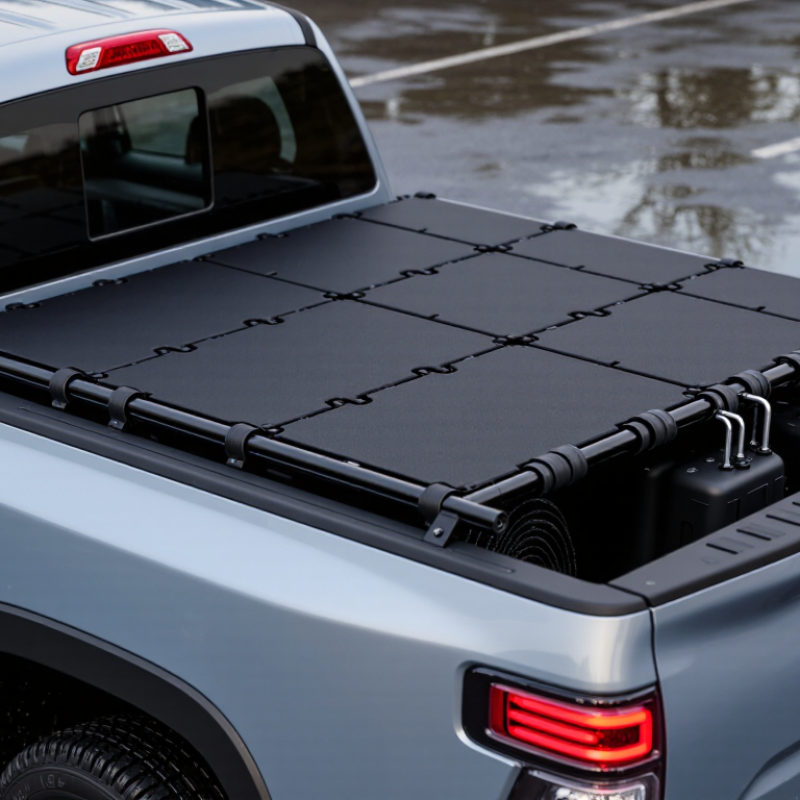
What Is an Electric Tonneau Cover and How Does It Work?

Definition and Core Parts: 12-V DC Motors, Rails, Seals, and Controllers

An electric tonneau cover is a powered bed cover that opens and closes with a 12-volt DC motor. The motor receives low-voltage power from the vehicle battery through a protected wiring harness. Pressing a dashboard switch or remote control sends a signal to the controller. The controller then manages motor direction, speed, and stopping points.

Rails guide the cover across the bed, keeping its movement straight and stable. They must stay aligned and free from dirt, because small debris can create drag or uneven movement. Seals sit along the cover edges and tailgate area. They help reduce water, dust, and wind entry, although no seal remains perfect forever. Rubber can shrink, harden, or flatten after long exposure to sunlight and temperature changes.

The controller acts as the system’s operating center. It may monitor current draw and stop the motor when resistance becomes unusually high. This feature can reduce damage, but it should not replace careful inspection. In practical use, the cover may sound louder in cold weather, and its travel can become slower when rails need cleaning. Correct grounding and secure connections matter more than many owners expect. A loose terminal can cause intermittent operation, which is easy to misdiagnose as motor failure. Installation instructions differ by design, so measuring rail spacing and checking seal contact before final tightening remains a sensible step.

How 12-V Electrical Power Drives Automated Cover Movement

What Is an Electric Tonneau Cover and How Does It Work?

An electric tonneau cover uses a 12-volt vehicle electrical system to move its panels or slats automatically. Pressing a switch sends current through a fused circuit to a control module and motor. The motor turns a drive shaft, which guides the cover along tracks near the truck bed rails. It feels simple from the driver’s seat. The mechanism is not simple inside.

A typical system includes a relay, wiring harness, gear reduction, and position sensors. The relay controls high current safely, while the fuse helps protect the circuit during a short or overload. Limit sensors tell the controller when the cover is fully open or closed. In workshop testing, a weak battery can make movement slow or uneven. Cold weather and packed dirt in the tracks can create similar symptoms.

Good installation matters more than many owners expect. Wires should stay away from sharp edges, exhaust heat, and standing water. Ground connections need clean metal contact. The cover should move smoothly before electrical adjustment begins. A motor may still run when alignment is poor, but it can strain the gears. That mistake is easy to miss. Weather seals also need regular inspection, because small gaps may let water reach the motor housing. I would not treat every fault as an electrical problem; mechanical resistance often comes first.

What Is an Electric Tonneau Cover and How Does It Work?

An electric tonneau cover uses a 12-volt vehicle power system to drive a motor that opens, closes, and positions the cover. Current demand rises when the motor starts or meets mechanical resistance, while standby electronics consume very little power.

The chart shows a representative current profile for a 12-volt automated cover cycle. Electrical power is calculated using P = V × I; at the nominal 12 V supply, a 15 A motor load requires approximately 180 W. Actual values vary with motor design, cover weight, temperature, battery condition, and track resistance.

Control Logic: Wireless Commands, Limit Sensors, and Obstruction Reversal

An electric tonneau cover uses a motor to open and close the truck bed. Its control logic decides when movement should start, stop, or reverse. A wireless command travels from a remote control or vehicle button to a receiver. The receiver checks the signal before activating the motor. If the signal is weak, the cover may respond slowly or not move. Small detail, big difference.

Limit sensors tell the controller where the cover begins and ends. One sensor confirms the fully open position. Another confirms the closed position. During setup, these sensors must align with the cover’s actual travel. A technician should test both positions several times. Misalignment can make the cover stop early or press against the tailgate. That is annoying. More importantly, it can increase mechanical stress.

Obstruction reversal is the main protective feature. If the moving edge meets a hand, cargo, or another object, motor resistance changes. The controller detects that change and stops the motor. It then reverses the cover a short distance. This response should be tested with a soft, safe object, never with a person’s hand. In real use, dust, cold weather, and uneven cargo can affect detection. During hands-on checks, I would inspect the rails and sensors regularly. The system is convenient, but no sensor is perfect. That deserves attention.

Weather Resistance Explained Through IP Ratings and Seal Standards

What Is an Electric Tonneau Cover and How Does It Work?

An electric tonneau cover uses a motor, gearbox, and guided slats to open or close the truck bed. Its weather resistance depends less on the motor itself and more on enclosure design. Water can enter through side rails, hinges, cable openings, and uneven tailgate gaps.

IP ratings provide a useful technical reference. Under IEC 60529, IP65 means dust-tight protection and resistance against water jets. IP67 adds temporary immersion protection, typically up to one metre for 30 minutes. However, IP67 does not automatically confirm water-jet performance unless both tests are declared. That detail is often missed. ISO 20653:2016 adapts ingress testing for road vehicles and includes demanding water conditions, including IPX9K testing.

A cover’s complete seal system should also consider compression, aging, and repeated movement. SAE J1455 provides environmental testing guidance for vehicle components, while rubber seal performance may be evaluated through compression-set methods such as ASTM D395. These references help engineers select materials and test procedures. They do not guarantee a leak-free truck bed after installation.

In practical inspections, I would check the drain paths first. A perfect seal can still trap water inside the rails. The cover should close evenly, without scraping or visible gaps. Cold weather, dust, and cargo vibration can reduce sealing pressure over time. IP data is valuable, but field conditions remain less controlled than laboratory tests. That is an uncomfortable limitation.

What Is an Electric Tonneau Cover and How Does It Work? — Weather Resistance Explained Through IP Ratings and Seal Standards
Data Dimension Typical Specification or Rating What It Means for an Electric Tonneau Cover Weather-Resistance Consideration
Basic Function Motorized opening and closing An electric motor drives the cover along side rails or rotates a connected shaft. The user normally operates it with a switch, remote control, or vehicle-integrated control. The electrical system should be protected from direct water entry, road spray, condensation, and debris during normal use.
Cover Construction Interlocking slats, hinged panels, or flexible powered material Hard slats generally provide a more controlled sealing surface, while flexible materials depend more heavily on side seals, front seals, and tailgate sealing geometry. The cover design, rail alignment, drain paths, and seal compression affect real-world water management more than the cover material alone.
IP Code Purpose IEC 60529 enclosure classification An IP code describes the protection provided by a specific enclosure against solid objects and water. It does not automatically certify the complete truck-bed cover installation. Always verify which component was tested, because a motor housing may have an IP rating while the complete cover, rails, wiring, and connectors may not share the same rating.
IP6X: Dust Protection Dust-tight The highest first-digit IP level indicates that dust is not expected to enter the tested enclosure in harmful quantities under the specified test conditions. This is useful for motors and control housings exposed to road dust, sand, and fine particles, but it does not describe water protection.
IPX4: Splash Protection Water splashing from any direction The tested enclosure is protected against splashing water from all directions under the applicable test conditions. Suitable for many ordinary splash exposures, but not equivalent to protection from high-pressure washing, heavy spray, or immersion.
IPX5: Water-Jet Protection Protection from water jets The enclosure is tested against water projected by a nozzle from different directions. This can be relevant to motor housings and connectors exposed to road spray, although installation orientation and cable-entry sealing remain important.
IPX6: Powerful Water-Jet Protection Protection from powerful water jets The enclosure receives a more demanding water-jet test than IPX5. It may provide additional resistance during severe spray or cleaning, but it still does not indicate immersion protection.
IPX7: Temporary Immersion Temporary immersion up to 1 m under specified conditions The tested enclosure is designed to withstand temporary immersion according to the applicable test procedure. IPX7 alone does not automatically guarantee protection against powerful water jets. A product tested for both conditions may use a dual designation such as IPX6/IPX7.
IPX8: Continuous Immersion Immersion beyond IPX7 conditions, as specified by the manufacturer The test depth and duration are not universally identical; they must be stated by the responsible manufacturer or test documentation. This rating applies only to the tested enclosure and defined conditions. It should not be interpreted as proof that an entire truck bed remains dry.
Front Header Seal Continuous compression seal A seal at the front of the bed closes the gap between the cover assembly and the bulkhead or cab-side area. The seal must remain correctly positioned and compressed. Dirt, distortion, poor fit, or insufficient compression can create a leak path.
Side-Rail Seals Gasket or brush-style sealing surfaces Side seals help guide water toward designated channels while limiting entry between the cover and the rails. Brush seals can allow controlled drainage and movement, whereas solid gaskets may require accurate alignment and consistent compression.
Tailgate Interface Overlapping or compression seal The rear seal manages the joint between the cover and the tailgate, one of the most variable areas on a pickup bed. Water resistance depends on tailgate design, adjustment, load movement, seal condition, and whether the tailgate is closed before the cover.
Drainage System Integrated channels and drain tubes Many powered covers collect water in the rails and route it through tubes toward the ground or existing body drainage points. Blocked, kinked, disconnected, or incorrectly routed drains can cause water to accumulate even when the seals are intact.
Cable and Connector Sealing Sealed connectors and protected cable entries Electrical connections should use suitable grommets, connector seals, or protected junctions to reduce water and corrosion exposure. The weakest connector, splice, or cable entry can determine practical weather resistance for the electrical system.
Water Resistance vs. Waterproofing Design-dependent, not absolute A weather-resistant cover is intended to reduce water entry during normal rain and road exposure; it is not necessarily watertight in every condition. Truck-bed covers commonly manage water through overlapping surfaces, seals, and drainage rather than creating a permanently sealed enclosure.
Pressure-Washing Limits Follow the installation and care instructions High-pressure water can force water past seals, cable entries, moving joints, and drainage interfaces even when a component has a high IP rating. Avoid directing a pressure-washer nozzle at close range toward seals, motor housings, connectors, and rail openings unless the product documentation specifically permits it.
Maintenance Factors Periodic inspection and cleaning Cleaning the rails, checking drain tubes, inspecting seals, and confirming fastener alignment helps preserve operating performance. Replace cracked, hardened, flattened, or displaced seals. Remove leaves, mud, and grit that could obstruct drainage or prevent full closure.
Practical Selection Rule Evaluate the complete system Compare the cover design, motor enclosure, connectors, seals, drainage arrangement, installation method, and documented test conditions. An IP rating is valuable evidence, but complete weather performance also depends on correct installation, vehicle fit, maintenance, and the condition of every sealing interface.
Note: IP ratings are defined for specific tested enclosures and conditions under IEC 60529. They should not be treated as a guarantee that the entire truck-bed cover system or cargo area will remain completely dry in every weather or washing situation.

Safety, Load Capacity, and SAE J1100 Pickup-Bed Dimensions

What Is an Electric Tonneau Cover and How Does It Work?

An electric tonneau cover uses a small motor to open, close, or retract panels across a pickup bed. A switch or remote sends power to the motor, while guides keep the cover aligned. Many systems include a manual release for power loss. The mechanism is convenient, but convenience does not replace inspection. I learned that dust, ice, and misaligned rails can increase resistance quickly.

Safety begins with movement control. Keep hands, tools, and loose clothing away from the rails. A cover should stop or reverse when it meets an obstruction, if that feature is provided. Test this function according to the instructions, not by forcing the panel. Check whether the closed cover blocks lamps, the rear camera, or the driver’s view. Never drive with an unsecured panel.

Load capacity needs careful interpretation. Some covers support only their own weight. Others allow limited static loading, but that rating may not apply while driving. Water, snow, and cargo can add unexpected force. Secure items below the cover and keep them away from moving parts. SAE J1100 provides standardized vehicle dimension terms, including pickup-bed references, yet it is not a universal fit guarantee. Measure bed length, width between rails, rail height, and tailgate clearance. Small differences matter. A cover can look strong without being a certified load platform. Verify the installation, rating, and vehicle-specific measurements before relying on it.