


News & Blogs

How to Choose Flex Neon Strip Lights in 2026?

Choosing a Flex Neon Strip in 2026 requires more than comparing brightness and price. The market is expanding, but product quality remains uneven. Grand View Research reports that the global LED lighting market reached approximately USD 81 billion in 2023, with continued growth expected through 2030. However, this broader figure does not represent every neon-style strip equally. Buyers still need to inspect construction, certification, and real operating performance.

Energy efficiency matters. The U.S. Department of Energy states that LED products can use at least 75% less energy than incandescent lighting and last considerably longer. Yet efficiency alone does not guarantee a reliable installation. Check the strip’s wattage per metre, operating voltage, heat dissipation, and expected lumen output. A bright sample on a showroom wall may perform differently inside a narrow aluminium channel. It may also show uneven colour after several months.

Look for a clear IP rating, especially around kitchens, storefronts, balconies, or covered outdoor signs. Review the bend direction and minimum bending radius before cutting. Confirm whether the power supply matches the total load, including voltage-drop losses on longer runs. UL, CE, RoHS, and relevant local approvals can strengthen confidence, but labels should be verified rather than assumed. A manufacturer’s technical sheet, testing report, warranty terms, and installation guidance reveal more than attractive product photography. Some choices remain subjective, too. Colour temperature, diffusion, and silicone finish should be judged under the actual viewing conditions, not only through online images.
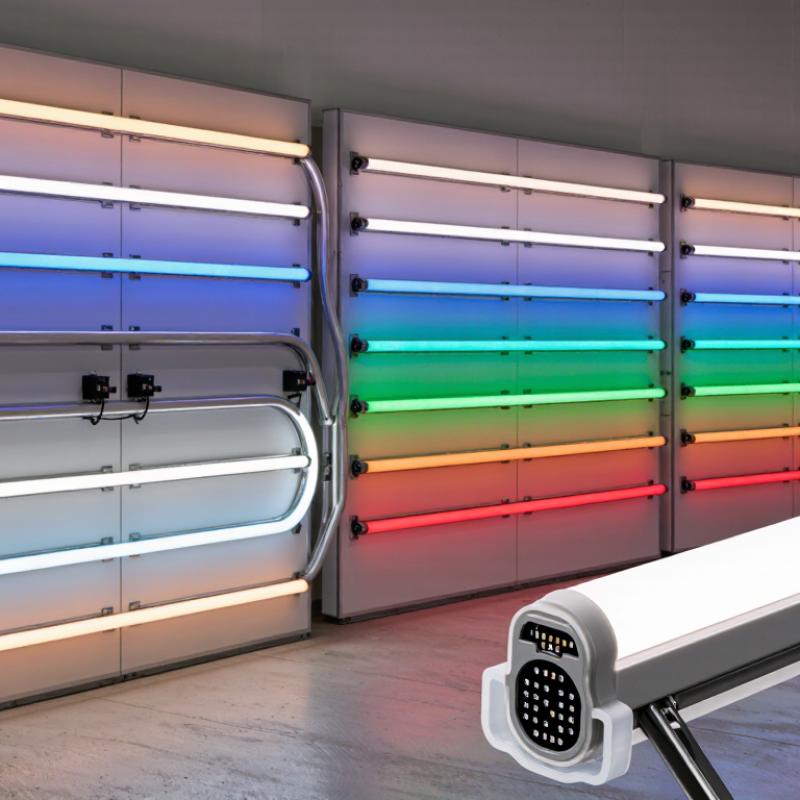
How to Choose Flex Neon Strip Lights in 2026?

What Flex Neon Strip Lights Are and How They Work

Flex neon strip lights are flexible LED assemblies sealed inside a silicone or similar diffuser. Unlike bare LED tape, they produce a continuous neon-like line with fewer visible light spots. Electricity reaches small LEDs mounted along a narrow circuit board. The diffuser spreads and softens their light. Some models bend vertically, while others bend sideways. This detail matters around signs, curves, and architectural edges.

The U.S. Department of Energy reports that LED products can use at least 75% less energy than incandescent lighting and last up to 25 times longer. That figure does not guarantee every neon strip will perform equally. Heat, poor power supplies, and incorrect installation can shorten its life. Check wattage per metre, voltage, colour rendering, and rated lifetime. For wet locations, use an enclosure with an appropriate IP rating. IEC 60529 defines the IP protection system, but the rating applies to the complete installation, not only the strip. This is often misunderstood.

Tips: Measure the route before buying. Confirm the bend direction and cutting intervals. Choose a power supply with spare capacity, rather than running it at its limit. For indoor displays, a high-CRI version usually shows colours more naturally. For outdoor use, inspect connectors, end caps, and seals carefully. A brighter strip is not always better; excessive brightness can create glare, waste energy, and expose weak heat management. My practical mistake was judging only the colour sample. The diffuser changed the result. Check it in the actual space.

How to Match Light Type, Brightness, and Color to Your Space

How to Choose Flex Neon Strip Lights in 2026?

Light type should follow the shape and purpose of your space. Top-bend neon suits straight shelves and signs, while side-bend versions follow curves more naturally. For general illumination, choose a single-color white strip. RGB or RGBW works better for visual accents, but colored light can distort food, skin, and material tones. The IES TM-30 method evaluates color fidelity more deeply than CRI alone, so review both when accurate appearance matters.

Brightness needs measurement, not guesswork. Compare lumens per meter, power consumption, and diffuser loss. A bright strip behind frosted acrylic may appear softer than its specification suggests. ENERGY STAR reports that certified LED lighting uses at least 75% less energy and can last up to 25 times longer than incandescent lighting. That is a useful efficiency benchmark, not a promise for every neon product. My first choice is rarely perfect.

Tips: Use 2200–2700K for intimate rooms, 3000–3500K for hospitality areas, and around 4000K for focused work. Test a one-meter sample before installation. Check color consistency at both ends. For damp locations, verify the complete system’s IP rating, including connectors and power supplies. The U.S. Department of Energy’s 2024 Solid-State Lighting report also stresses system performance, because drivers, heat, and installation can reduce real-world efficiency. Measure twice. Then question the specification.

How to Check Waterproofing, Materials, and Safety Standards

How to Choose Flex Neon Strip Lights in 2026?

Waterproofing should match the installation, not just the product description. For outdoor walls, balconies, or garden paths, check the IP rating carefully. A higher rating can resist dust and water, but it does not make poor installation safe. Inspect the silicone jacket for bubbles, thin spots, or open seams. I once ignored a small end gap, and moisture reached the copper conductors after heavy rain. That mistake was preventable. Confirm whether the strip is designed for temporary splashes, direct rain, or constant exposure. These conditions are different.

Tips: Bend the strip gently, never sharply. Seal every cut end with compatible materials. Keep connectors above standing water. Test a short section before installing the full length.

Material quality affects brightness, flexibility, and service life. Dense silicone usually protects better than brittle plastic, while copper conductors should feel consistent along the strip. Ask for the operating temperature range and confirm the power supply matches the required voltage. A correctly sized aluminum profile can reduce heat, especially in long indoor runs. However, profiles may not solve poor ventilation. I used to assume more cooling was always better; sometimes the profile simply added cost without improving performance.

Safety markings deserve careful checking. Look for documentation from a recognized testing body, clear electrical ratings, and installation instructions. Certification names and requirements vary by country, so verify local rules before purchase. Use a qualified electrician for mains connections. Low voltage is safer, but it still requires correct polarity, fusing, and strain relief. Never rely on attractive lighting alone.

How to Choose the Right Power Supply, Controls, and Installation Method

How to Choose Flex Neon Strip Lights in 2026?

Choosing flex neon strip lights starts with the power supply, not the color. Check the strip’s voltage, wattage per meter, total length, and a safety margin of at least 20%. A five-meter, 12-watt-per-meter installation needs 60 watts; a 75-watt supply is more practical. The U.S. Department of Energy reports that LED systems can deliver major energy savings across their service life, but poor power conversion still creates waste and heat (DOE, Energy Savings Forecast of Solid-State Lighting, 2019). Use a regulated supply with suitable indoor or outdoor protection. Never hide it inside an unventilated cavity.

Controls should match the project’s daily use. A simple dimmer suits a fixed display, while addressable systems need compatible controllers, data wiring, and careful channel planning. The Zhaga Consortium’s interface guidance highlights the value of standardized control connections for future maintenance (Zhaga Book 18). That matters when one failed controller should not darken an entire facade. Keep signal cables short where possible. Test color consistency before sealing channels.

Installation quality decides whether the light looks professional. Provide aluminum profiles for cooling, clean the mounting surface, and respect the strip’s bend radius. Waterproof products still need sealed joins. I have seen beautiful lighting fail because installers trusted adhesive alone. It happens. Leave accessible service points, label every cable, and test the system for several hours before final closure. The IEA’s 2024 lighting analysis also stresses efficient equipment and better system design, not just efficient lamps.

How to Compare Lifespan, Energy Use, Warranty, and Total Cost

How to Choose Flex Neon Strip Lights in 2026?

Lifespan should be checked beyond the advertised number. The U.S. Department of Energy’s Solid-State Lighting Technology Fact Sheet reports that LED systems can reach 50,000 hours under controlled conditions. Real installations often perform differently. Heat, moisture, tight bends, and poor drivers can shorten service life. At eight hours daily, 50,000 hours equals about 17 years. That calculation looks impressive. It is not a promise.

Energy use needs a simple measurement. A 10-meter strip rated at 12 watts per meter consumes 120 watts. Running eight hours daily uses about 350 kilowatt-hours annually. At $0.16 per kilowatt-hour, electricity costs roughly $56 each year. The International Energy Agency’s Energy Efficiency 2024 report identifies lighting as a major electricity-use category, making efficient conversion important. Check watts per meter, brightness, and operating hours together. Brightness alone can mislead.

Warranty terms reveal practical quality. Compare coverage length, driver inclusion, outdoor exclusions, color-fade rules, and proof-of-installation requirements. A five-year warranty may be weaker than a three-year warranty with clear replacement terms. Calculate total cost using purchase price, controllers, aluminum channels, labor, electricity, and likely replacement waste. One overlooked detail matters: a failed driver can disable an entire run. I would also question optimistic lifetime claims when thermal testing is missing. Industry data helps, but installation evidence matters more.

How to Choose Flex Neon Strip Lights in 2026?

Compare lifespan, energy use, warranty, and estimated 10-year ownership cost using representative, brand-neutral specifications.

Light Type Rated Life Power Use Typical Warranty 10-Year Cost per Meter
Standard Indoor LED Neon 30,000 hours 14 W/m 2 years $86.32
High-Efficiency LED Neon 50,000 hours 8 W/m 3 years $87.56
Outdoor-Rated LED Neon 50,000 hours 12 W/m 5 years $123.84

The chart uses a 0–100 comparison score, where higher is better. Scores are calculated from the listed specifications: lifespan is compared with the longest rated life, energy efficiency favors lower wattage, warranty favors longer coverage, and total cost favors lower spending. Ownership cost assumes 8 hours of operation per day for 10 years, electricity at $0.15 per kWh, and an estimated product cost of $25, $35, and $45 per meter respectively. Installation, controls, and maintenance are excluded.

Article Source: