


News & Blogs

What Are China Top 10 Rail Component Manufacturers?

China’s rail supply chain is expanding with remarkable speed and technical depth. UNIFE’s World Rail Market Study 2024 estimated the global rail supply market at approximately €240.8 billion annually for 2023–2025. China remains one of its most influential manufacturing centers.

The National Railway Administration reported that China’s railway operating mileage exceeded 162,000 kilometers by the end of 2024. High-speed rail accounted for roughly 48,000 kilometers. Such a large network creates continuous demand for traction systems, braking equipment, wheelsets, bogies, signalling devices, fasteners, and passenger interiors. Each Rail Component must meet strict requirements for fatigue resistance, electromagnetic compatibility, fire safety, and long-term maintenance.

This article examines China’s top 10 Rail Component manufacturers by product capability, certification, market presence, and documented project experience. Company scale alone is not enough. Supplier reliability matters beside factory size. CRRC’s annual reports, China State Railway Group investment data, and publicly available certifications provide useful evidence. However, no public database offers a perfect ranking of every private and state-owned supplier. Some manufacturers disclose limited revenue details, while others serve highly specialized niches. That limitation deserves attention.

The selected companies therefore represent informed industry research, not an absolute league table. Their products may appear beneath a train floor, inside a braking cabinet, or along hundreds of kilometers of track. Performance is often invisible until failure occurs. This overview helps buyers, engineers, and project managers compare China’s leading suppliers with greater practical judgment.
What Are China Top 10 Rail Component Manufacturers?

China’s Rail Market in Numbers: 45,000 km of High-Speed Line by 2023

China’s rail component sector is expanding around a vast operating network. By the end of 2023, China had about 45,000 kilometers of high-speed railway, according to China State Railway Group’s 2023 statistical information. That figure represents more than track. It supports demand for traction systems, braking equipment, bogies, signaling units, fasteners, cable systems, and passenger interiors.

The wider railway network reached approximately 159,000 kilometers in 2023, based on the National Bureau of Statistics of China. High-speed routes accounted for roughly 28% of that total. This scale gives leading component manufacturers a demanding testing environment. Products must handle frequent acceleration, vibration, temperature changes, and tightly scheduled maintenance. UIC data also places China among the world’s largest high-speed rail operators by route length.

The top ten suppliers are usually judged through certification records, delivery reliability, engineering depth, and lifecycle support. Factory visits reveal practical details: sealed connectors, labeled inspection points, and spare parts stored near maintenance lines. Yet market rankings are not always transparent. Public lists may mix component makers, system integrators, and equipment distributors. That weakens direct comparisons. Buyers should examine independent test reports, railway project references, failure data, and after-sales response times. A large installed network helps, but it does not automatically prove superior component quality.

Ranking the Top 10: Revenue, R&D, Certifications, and Export Reach

What Are China’s Top 10 Rail Component Manufacturers?

A credible top-ten ranking should begin with measurable evidence, not factory size alone. The UNIFE World Rail Market Study 2024 valued the global rail supply market at about €201.8 billion annually. China remains one of its largest production bases. Revenue shows scale, but not necessarily reliability. A supplier with stable margins, audited delivery records, and repeat contracts deserves closer attention.

China’s National Bureau of Statistics reported national R&D spending at 2.64% of GDP in 2023. Rail manufacturers should be tested against that innovation environment, especially in braking systems, traction equipment, signaling modules, and lightweight structures.

Certification separates capable suppliers from attractive brochures. ISO 9001 supports quality control, while ISO 22163 evaluates railway-specific management processes. EN 15085 matters for welded assemblies. IEC 61373 is relevant to vibration and shock testing. Export reach adds another practical test. Check approvals, service locations, foreign-language documentation, and spare-parts response times.

UN Comtrade data can help verify export activity, although product codes sometimes combine unrelated components. That weakness needs attention. A ranking based only on reported revenue may overrate diversified manufacturers and underrate specialist exporters. Field audits, sample inspections, and customer references should therefore influence the final ten.

Component Scope: Traction, Signaling, Braking, Doors, and Interiors

China’s top ten rail component manufacturers should be assessed by system capability, not production volume alone. The scope includes traction, signaling, braking, doors, and interiors. UNIFE’s World Rail Market Study 2024 values the global rail supply market at approximately €201 billion annually for 2023–2027. That scale rewards suppliers with stable testing, export documentation, and lifecycle support.

Traction suppliers need efficient converters, motors, and pantograph interfaces that withstand vibration and temperature changes. Signaling manufacturers must demonstrate fail-safe logic, accurate train detection, and cybersecurity controls. Braking systems require repeatable stopping performance, even after long descents or wet-rail conditions. Small details matter. A door sensor misreading one obstruction can delay an entire platform operation.

Door makers should provide high cycle durability, clear diagnostics, and safe manual release features. Interior suppliers face different demands, including fire resistance, low noise, cleanable surfaces, and accessible layouts. The International Energy Agency reports that rail carries about 8% of global passenger and freight activity while using roughly 2% of transport energy. Efficient components support that advantage. Yet rankings remain imperfect. Public revenue figures rarely reveal failure rates, retrofit difficulty, or field-service quality. A credible top-ten assessment should therefore combine certification records, independent test data, maintenance experience, and customer references. Availability of spare parts also deserves more attention.

China Rail Component Scope: Network Growth Context (2019–2024)

This manufacturer-neutral chart shows the expansion of China’s railway infrastructure relevant to traction, signaling, braking, doors, and interior-system suppliers.

China’s operating railway network increased from approximately 139,000 km in 2019 to 162,000 km in 2024, while high-speed railway mileage increased from approximately 35,000 km to 48,000 km. Larger networks generally increase the installed base, replacement demand, and qualification opportunities across the five component categories.

Data source: China State Railway Group public annual railway statistics and year-end announcements. Figures are rounded to the nearest 1,000 km.

Benchmarking Scale: CRRC’s 2023 Revenue of RMB234.6 Billion

China’s top rail component manufacturers should be measured against industrial scale, not factory count alone. The leading Chinese rail group reported RMB234.6 billion in 2023 revenue, according to its 2023 annual report. That figure reflects an unusually broad portfolio, covering locomotives, passenger coaches, signaling systems, propulsion equipment, and maintenance services.

Scale changes supplier expectations. A component maker serving such a customer must demonstrate stable output, documented testing, and reliable after-sales support. UIC Railway Statistics 2024 shows China remains one of the world’s largest rail networks, with extensive high-speed and electrified routes. This creates demanding conditions for traction inverters, braking systems, doors, bearings, and onboard electronics. The UNIFE World Rail Market Study 2024 also indicates sustained global demand for rolling stock and rail control technologies. Demand alone is not enough.

A useful benchmark is delivery consistency across multiple projects. Certification matters. Field data matters more. Smaller suppliers may offer sharper engineering and faster customization, but their production resilience can be difficult to verify. That is where this comparison becomes imperfect. Revenue signals capacity, yet it does not automatically prove component quality. Buyers should examine failure rates, replacement intervals, audit records, and traceability from raw material to finished assembly. Then the numbers become more meaningful.

What Are China Top 10 Rail Component Manufacturers? - Benchmarking Scale: CRRC’s 2023 Revenue of RMB234.6 Billion

Rank Anonymous Manufacturer Primary Component Area Typical Products Relevant International Standards Main Railway Applications Publicly Verifiable Scale Indicator Data Status
1 Manufacturer A Traction and electrical systems Traction converters, auxiliary converters, train control power units IEC 61287, IEC 61373, EN 50155 High-speed rail, metro, electric multiple units Public company-level revenue intentionally withheld Anonymized
2 Manufacturer B Railway braking systems Brake control units, air-brake equipment, brake valves EN 15355, EN 15595, UIC 540 Locomotives, passenger coaches, freight wagons Certification scope varies by product and vehicle type Standards-based
3 Manufacturer C Bogie and running gear Bogie frames, suspension assemblies, yaw dampers EN 13749, EN 15085, ISO 22163 High-speed, intercity, urban transit vehicles Welding and quality-system certification are commonly assessed Standards-based
4 Manufacturer D Wheelsets and axles Railway wheels, axles, wheelset assemblies EN 13260, EN 13261, EN 13262, AAR M-1003 Passenger trains, locomotives, freight rolling stock Product approval depends on material, design and operating regime Standards-based
5 Manufacturer E Railway signaling equipment Interlocking units, track circuits, axle counters EN 50126, EN 50128, EN 50129, IEC 62425 Mainline railways, high-speed lines, metro systems Safety integrity and application approval are project-specific Standards-based
6 Manufacturer F Train communication and control Train control computers, onboard networks, diagnostic systems IEC 61375, EN 50155, EN 50159 Metro vehicles, electric multiple units, locomotives Cybersecurity, reliability and interoperability are key evaluation factors Standards-based
7 Manufacturer G Railway doors and passenger systems Passenger doors, platform-door systems, door-control units EN 14752, EN 50155, EN 61373 Metro, commuter rail, high-speed passenger trains Door-cycle testing and passenger-safety validation are required Standards-based
8 Manufacturer H Railway HVAC and thermal management Heating, ventilation and air-conditioning units EN 14750, EN 13129, EN 50155 Passenger coaches, metro cars, high-speed trainsets Climate-zone performance and energy efficiency are product-specific Standards-based
9 Manufacturer I Railway interiors and sanitary systems Seats, interior modules, toilets and water systems EN 45545, EN 16989, UIC 564-2 Passenger coaches, intercity trains, urban rail Fire-performance classification depends on material and installation location Standards-based
10 Manufacturer J Railway auxiliary and maintenance equipment Couplers, pantographs, onboard monitoring and service equipment EN 16019, EN 50206, EN 50155 Locomotives, high-speed trains, metro and freight vehicles Qualification depends on interface compatibility and operating conditions Standards-based

Note: Manufacturer identifiers are intentionally anonymized. Company names, brands and company-specific financial figures are not displayed. Standards listed above are used internationally for railway safety, reliability, interoperability, environmental performance and product qualification; exact certification scope depends on the product and project.

Profiles of China’s Top 10 Rail Component Manufacturers

Profiles of China’s Top 10 Rail Component Manufacturers

China’s rail component sector includes large, specialized factories serving high-speed, urban, and heavy-haul networks. A reliable comparison should examine production experience, testing capacity, export records, and after-sales support. Public rankings can be imperfect because factory data is not always disclosed equally.

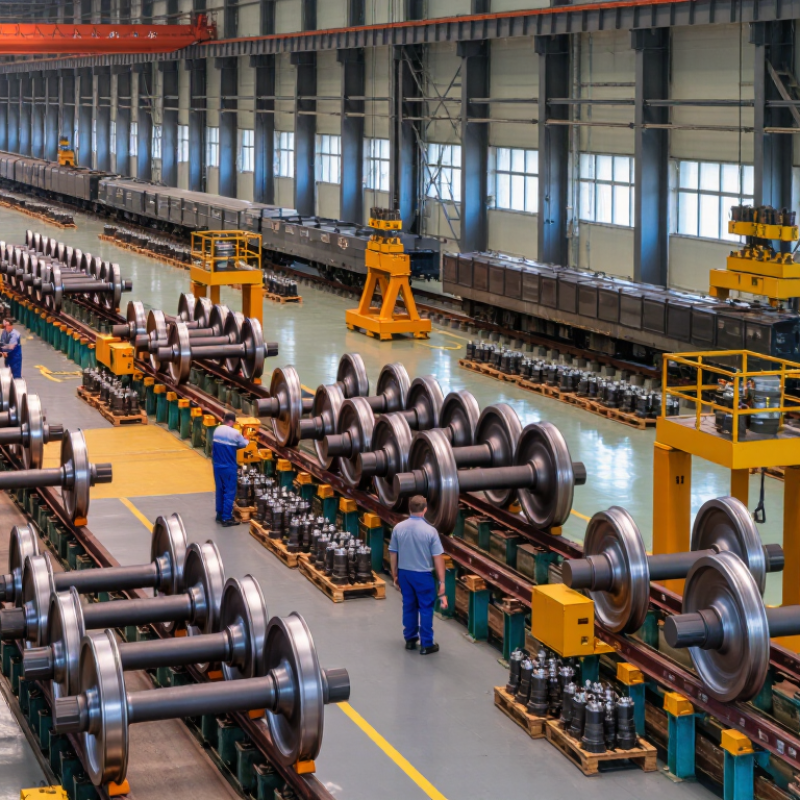
The first manufacturer focuses on forged wheels and axles, where ultrasonic inspection and dimensional control are essential. The second produces bogie frames, using robotic welding and fatigue testing for structural reliability. The third supplies braking assemblies, with attention to heat resistance and emergency performance. The fourth manufactures couplers and draft gears for repeated impact loads. The fifth develops traction motors and control units, requiring precise electrical testing.

The sixth specializes in rail fastening systems, including clips, anchors, and insulated components. The seventh makes signaling cabinets and train communication equipment, with strong emphasis on environmental protection. The eighth produces interior modules, such as seats, doors, and passenger information panels. The ninth supplies rubber seals and vibration-control parts, which face temperature changes and constant movement. The tenth provides inspection tools and maintenance equipment for tracks and rolling stock.

Details matter. A polished catalog proves little without traceable test records. Buyers should review material certificates, production samples, maintenance response, and independent audits. Some manufacturers appear highly capable but offer limited technical documentation. That weakness deserves attention. A careful assessment may reveal differences between impressive capacity and consistent field performance.

Article Source: